Showing posts with label dice. Show all posts

Friday, June 5, 2009

Favorite Books

When someone asks you what your favorite books are, how do you respond? In my youth i believed that musical taste effectively sorted people into their social groups. But then i met persons who had no musical interests and that was confusing. No musical interests!? They seemed like another species. Of course non-readers are much more common than non-music-listeners. And a person's reading taste tells considerably more about her or his personality and sensibilities than knowing what music that person likes.

As a bookseller, i have been asked frequently what are my favorite books. There are so many books i have liked and loved that it is hard to know where to begin. There are numerous ways in which i appreciate books and when i am asked to name my favorites, i precede my answer by explaining that i divide my favorite books into two main groups: Books i loved the most and books that influenced me the most. The former are generally literary and the latter are more often non-fictional. Today i will focus on books i have loved. I have loved them for transporting me to other worlds. Some i have loved so much that the mere sight of a copy makes me breathless. Before i list this short list of favorite books, i want to tell you why they are older titles and explain a few things about my taste.

In our bookstore, i have had access to some of our city's most literate minds. And i have been overwhelmed by the choice of books for my entire life. In a former blog, i believe i mentioned that i sequence my reading of the books i want to read by rolling dice. It has been a long standing conflict for me whether, i should read newly released books or whether i should read the best books from the gigantic backlist of books published before my time. More often, my philosopher self wins out and so i am maybe surprisingly behind on recent releases. My preference for excellent books versus new books, combined with my dice system also leaves me with big holes in my literary knowledge. For instance, i have read Gargantua and Pantagruel, but am yet to read John Steinbeck.

The main two components of a book's content are its narrative and the style in which it is written. I think them as a room: writing style is the door and the story is the decor and furnishings, which one will never see if one can't get through the door. So don't mistake me for a shallow reader when i assert that writing style may not be more important than the narrative, but that the narrative is inaccessible without the door of good style, which involves many things. The very best books have both, but i believe that a well written book with little to say will be better received than a poorly written good story.

In my reading, style is primary. There are too many books and too few years in our lives to waste time with badly written books. The novelist and great teacher John Gardner (American) has elucidated what i am saying as well as anyone.

So here is a list of eleven books i truly love. They are stylistically wonderful and i enjoy the stories. I lead a fairly stable and thoughtful life without too much chaos, so it might be surprising what odd, indeed lunatic narratives, some of these stories have. I love oversleeping and fever dreams, and i find pleasure even in my nightmares.

These titles are culled from a larger list i keep. I will list them by their age.

Steppenwolf by Herman Hesse. 1927. Many call it dark and depressing. I found it enlightening and enchanting.

The Last Nights of Paris by Philippe Soupault. 1929. A surreal dreamy romance.

The Journal of Albion Moonlight by Kenneth Patchen. 1941. An irrational psychotic tale of madness induced by world war II. Beautiful prose. Troubling.

Silence by John Cage. 1961. Though generally found in music, i think of it as poetry and philosophy. This is the only book on this list that i also put on my list of most influential books.

Do Androids Dream of Electric Sheep? by Philip K. Dick. 1968. A touching distopian novel.

Pricksongs and Descants by Robert Coover. 1969. A collection of mysterious and sensual meta-fictional stories, many based on tales you know.

The Dice Man by Luke Rhinehart. 1971. A very funny lunatic tale of a man who lives his life by dice. No, i didn't learn my habit from this book but i am friends with the author because of my habit.

Gravity's Rainbow by Thomas Pynchon. 1973. Almost as hard as Joyce. Crazy tale of the final days of World War II. Amazing prose. Read it out loud for best experience and survival.

Dhalgren by Samuel R. Delany. 1975. A thick and dark post apocalyptic tale about a nearly dead world. liked by Pynchon fans but much easier to read.

What We Talk about When We Talk about Love by Raymond Carver. 1981. Tight nuanced stories about troubled working class people and how they worsen their problems by making bad decisions.

The New York Trilogy by Paul Auster. First published separately as City of Glass (1985), Ghosts (1986), and The Locked Room (1986). The novellas read like hard boiled mysteries written with the tight prose of Carver from the outlook of Franz Kafka. Wonderful.

If you love these books too, please send me your recommendations. I live in fear that i will miss great books.

C'est tout for now.

Bone... from Thon, from Anthony, from Kip. You know, bones are dice and what holds our bodies up.

Saturday, May 2, 2009

Growing Up With Books

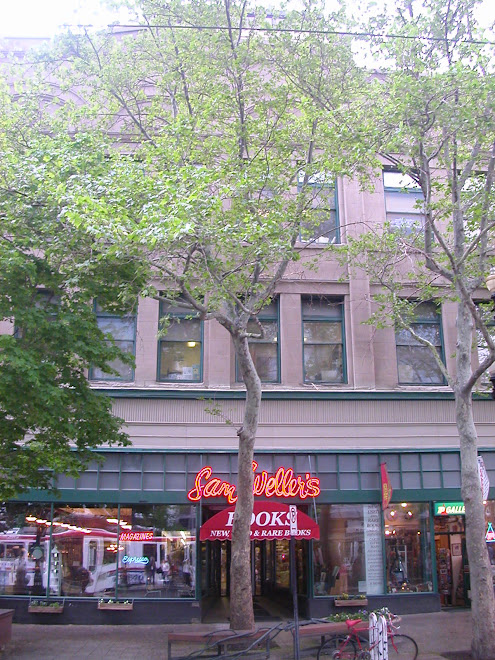
As the only child in a bookselling family in which both parents worked, i spent many childhood hours in our family bookstore. In the 1960's, bookstores were still cultural centers of communities. Downtown areas had not yet been eviscerated by speculation, urban sprawl and suburban mall development. Wall Street had not yet overfed corporations, enabling them to grow beyond sustainability. Books were still a part of many peoples lives. Though i didn't recognize them as such, those were the golden days of the book industry.

As a child, i trolled the bookstore soaking up influence from the booksellers who were employed by my parents. I was born in 1962 so i call myself an infant boomer. Though i was too young to be a true participant in the culture of the era, my cultural, political, philosophical and musical outlooks were shaped by the 1960's. Of course i took books and reading for granted.

In school, i often felt like an outsider. I was drawn to other outsiders and even misfits. I was troubled by the meanness of children. Of the three communities where i spent much time - school, the bookstore, and church - the bookstore seemed like the most enlightened. It was at church and school that i learned racial slurs, sexism and bigotry. Even as a child, i knew these ways of thinking were stupid and wrong. At my parents bookstore, people of color in this, especially then, predominantly white community, were treated with respect. A gay couple who worked here received the same respect. Since most of bigotry to which i was exposed was of other kids, i presumed that open-mindedness, creativity and intelligence were functions of maturity. I didn't then realize that the crap coming out of kids' mouths was probably learned from their parents. So i bid my time through my school years, waiting for the magical world of enlightened adults to become reality. I wouldn't give up on this fairy tale until i reached college.

As a child, i read quite a bit. I was also a prankster. Math came easily to me. I was thoughtful and analytical and often stymied by decision making. I received from my father Sam, my first Beatles record, Meet the Beatles, when i was about five. I thought it was the coolest thing i had ever heard and played it incessantly, rocking out by myself in my bedroom. I was surprised that none of my friends seemed to care much about rock and roll. I don't think i had a friend who shared my interest in music until about fourth grade, when i met Chris Bertagnole. He was my first rock buddy and we are still friends today.

I met another good friend, Robert Baxter, at a neighborhood garage fire. I think we were in third grade. My school in the lower avenues, Longfellow, had recently been torn down to make room for parking for the Mormon ward next door. I had been transferred to Ensign, where i had seen Robert, but not really made his acquaintance. When we each saw smoke and were drawn to the burning garage, we met in our mutual neighborhood and became fast friends. Between 3rd and 12th grade, we perpetrated more pranks and stunts than i can even remember. We specialized in the unusual and in a later blog i might write about some of our more successful efforts. We are still friends today.

I am a small man and i was a small boy. I recall becoming frustrated at my lack of athletic prowess about half way through elementary school. The most resonant memory is having to leave recess pick-up basketball games because there were always 10 players who were better than i. So i whined to my father. He's now too frail to resemble the man he was then, but my father, Sam Weller was an aggressive, can-do, go-getter. Not a quitter. Neither did he have much patience for whining. He said, "well, you'll just have to practice until you're good enough to make the games." He had already hung a hoop in the driveway but then he proceeded to play ball with me every night after work. No whining. So i gradually shed most of my woosiness and became a good basketball player. Within a year, i was not only included in every playground game, i was frequently captain of a team. My father's can-do aggression became my first lesson in the value of perseverance, one i am now imparting to my own daughter.

I mentioned that math came easily to me. I dug math because it seemed to be without ambiguity. As a child i was sometimes nearly incapacitated with indecision. I was a very lucky boy in that i had nearly three parents. My mother, Lila Weller, had a very close friend in Margaret Smith and Margaret was like a member of our family. She traveled with us and my parents left me with her every Sunday, after the Mormon church i was then forced by Sam to attend. With Margaret, i played many games and i suspect, because i was so young that i cannot do better, that it was game playing that first gave me the idea to overcome indecision with chance. I recall coloring coloring books, by chance. I would dump all my crayons into a shoe box and place it behind myself. Then i would decide what i would color and grab a random crayon and color it. Later, i overcame indecision about getting dressed in the morning by pulling cards from decks to determine what i would wear. I think i was in either 4th or 5th grade when i realized that dice were the most useful tools for chance decision making. It is a habit i have refined over the years and i can't leave home without dice without feeling insecure. But more about dice later.
Last, i want to mention the influence books had on me in my 11th year. When i was in 6th grade, i precociously decided that i was too old for juvenile books. That's why i missed so many great young adult novels until i had my own child. When i made this decision, the movie version of The Exorcist was new and news reported viewers barfing in theaters. That seemed pretty cool to my 11 year old sensibilities. Too young to get into the movie, i decided to read the book. It was my first adult read. The second was Carrie by Stephen King. Then i started smuggling books on sex and drugs out of my parents bookstore. Not that i had actually encountered sex or drugs yet, but the boomer scientist in me just had to learn. Those early studies helped me to navigate my teen years with fewer problems than i might have had had i been navigating without information. Those experiences form the seminal basis in my opposition to censorship.

So i am now a rather OCD 47 year old who needs to quit pounding this keyboard. Since i have created an outline of things i intend to eventually blog, i thought this background might prove useful in explaining what will follow. I hope i haven't bored you.

Bone