When someone asks you what your favorite books are, how do you respond? In my youth i believed that musical taste effectively sorted people into their social groups. But then i met persons who had no musical interests and that was confusing. No musical interests!? They seemed like another species. Of course non-
readers are much more common than non-
music-listeners. And a person's reading taste tells considerably more about her or his personality and sensibilities than knowing what music that person likes.
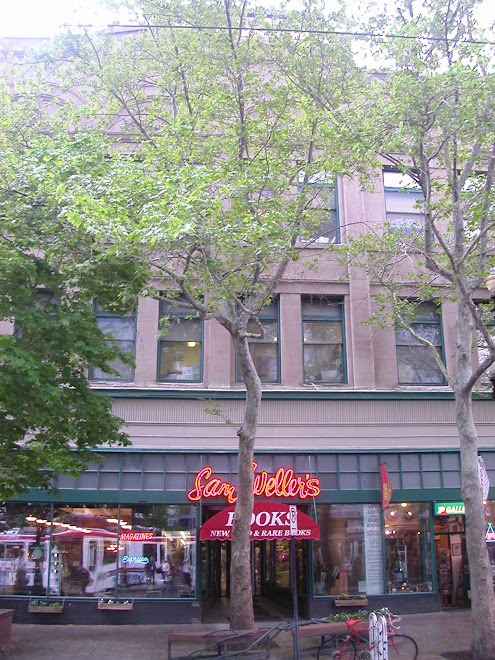
As a bookseller, i have been asked frequently what are my favorite books. There are so many books i have liked and loved that it is hard to know where to begin. There are numerous ways in which i appreciate books and when i am asked to name my favorites, i precede my answer by explaining that i divide my favorite books into two main groups: Books i
loved the most and books that
influenced me the most. The former are generally literary and the latter are more often non-fictional. Today i will focus on books i have loved. I have loved them for transporting me to other worlds. Some i have loved so much that the mere sight of a copy makes me breathless. Before i list this short list of favorite books, i want to tell you why they are older titles and explain a few things about my taste.
In our bookstore, i have had access to some of our city's most literate minds. And i have been overwhelmed by the choice of books for my entire life. In a former blog, i believe i mentioned that i sequence my reading of the books i want to read by rolling dice. It has been a long standing conflict for me whether, i should read newly released books or whether i should read the
best books from the gigantic backlist of books published before my time. More often, my philosopher self wins out and so i am maybe surprisingly behind on recent releases. My preference for excellent books versus new books, combined with my dice system also leaves me with big holes in my literary knowledge. For instance, i have read Gargantua and Pantagruel, but am yet to read John Steinbeck.
The main two components of a book's content are its narrative and the style in which it is written. I think them as a room: writing style is the door and the story is the decor and furnishings, which one will never see if one can't get through the door. So don't mistake me for a shallow reader when i assert that writing style may not be more important than the narrative, but that the narrative is inaccessible without the door of good style, which involves many things. The
very best books have both, but i believe that a well written book with little to say will be better received than a poorly written good story.
In my reading, style is primary. There are too many books and too few years in our lives to waste time with badly written books. The novelist and great teacher John Gardner (American) has elucidated what i am saying as well as anyone.
So here is a list of eleven books i truly love. They are stylistically wonderful and i enjoy the stories. I lead a fairly stable and thoughtful life without too much chaos, so it might be surprising what odd, indeed lunatic narratives, some of these stories have. I love oversleeping and fever dreams,
and i find pleasure even in my nightmares.

These titles are culled from a larger list i keep. I will list them by their age.
 Steppenwolf
 by Herman Hesse. 1927. Many call it dark and depressing. I found it enlightening and enchanting.
The Last Nights of Paris by Philippe Soupault. 1929. A surreal dreamy romance.
 The Journal of Albion Moonlight
 by Kenneth Patchen. 1941. An irrational psychotic tale of madness induced by world war II. Beautiful prose. Troubling.
 Silence
 by John Cage. 1961. Though generally found in music, i think of it as poetry and philosophy. This is the only book on this list that i also put on my list of most influential books

.
Do Androids Dream of Electric Sheep? by Philip K. Dick. 1968. A touching distopian novel.
Pricksongs and Descants by Robert Coover. 1969. A

collection of mysterious and sensual meta-fictional stories, many based on tales you know.
 The Dice Man
 by Luke Rhinehart. 1971. A very funny lunatic tale of a man who lives his life by dice. No, i didn't learn my habit from this book but i am friends with the author because of my habit.
Gravity's Rainbow by Thomas Pynchon. 1973. Almost as hard as Joyce. Crazy tale of the final days of World War II.

Amazi

ng prose. Read it out loud for best experience and survival.
Dhalgren by Samuel R. Delany. 1975. A thick and dark post apocalyptic tale about a nearly dead world. liked by Pynchon fans but much easier to read.
What We Talk about When We Talk about Love by Raymond Carver. 1981. Tight nuanced stories about troubled working class

people and how they worsen their problems b

y making bad decisions.
The New York Trilogy by Paul Auster. First published separately as City of Glass (1985), Ghosts (1986), and The Locked Room (1986). The novellas read like hard boiled mysteries written with the tight prose of Carver from the outlook of Franz Kafka. Wonderful.

If you love these books too, please send me your recommendations. I live in fear that i will miss great books.
C'est tout for now.
Bone... from Thon, from An
thony, from Kip. You know, bones are dice and what holds our bodies up.